

August, 1889

I knew what I needed instantly, being not a creature of fashion, but a gentleman who, in other time, preferred to carry a rosary instead of a time devouring watch. My own rosary, the one I had preserved, has become brittle with age, and its cord, though of high quality silk, was by 1889, a pure relic. In my mind, I have fashioned a black jet rosary with an oval medal, and set of initials inlaid in silver, and only one man could make those: Thomas Andrews, the magician of Whitby.
A venerable, silver haired man of quiet dignity, he was the jeweler to Her Majesty, and a beloved member of community. But to me, he was a fellow traveller, a man who was much older than he looked—and people thought he was well above eighty. I have known him since the days of Queen Anne and back then he was a royal jeweler of an unsurpassed talent. Visiting him now was much like turning the wheel of time.
He met me cordially and hearing me out, nodded.
"I have an array of beads that would do well," he conceded, showing me a small chest of black jet beads. Each one had been painstakingly carved into the likeness of a blooming rose, the petals sharp and delicate beneath his touch. "I have been making those for the last month, when my mind prompted me to return to the past. Long memory is a heavy thing to carry, old friend... The medal... it would not take long. I suggest you take a walk by the sea and return in an hour or two. I shall be ready by then."
When I returned, the shop was silent, the scent of oil and ancient dust hanging heavy in the air. On a swatch of charcoal silk lay the finished work. It was a sequence of thirty-one jet roses and spheres—one bead for every year Monty had walked this earth.
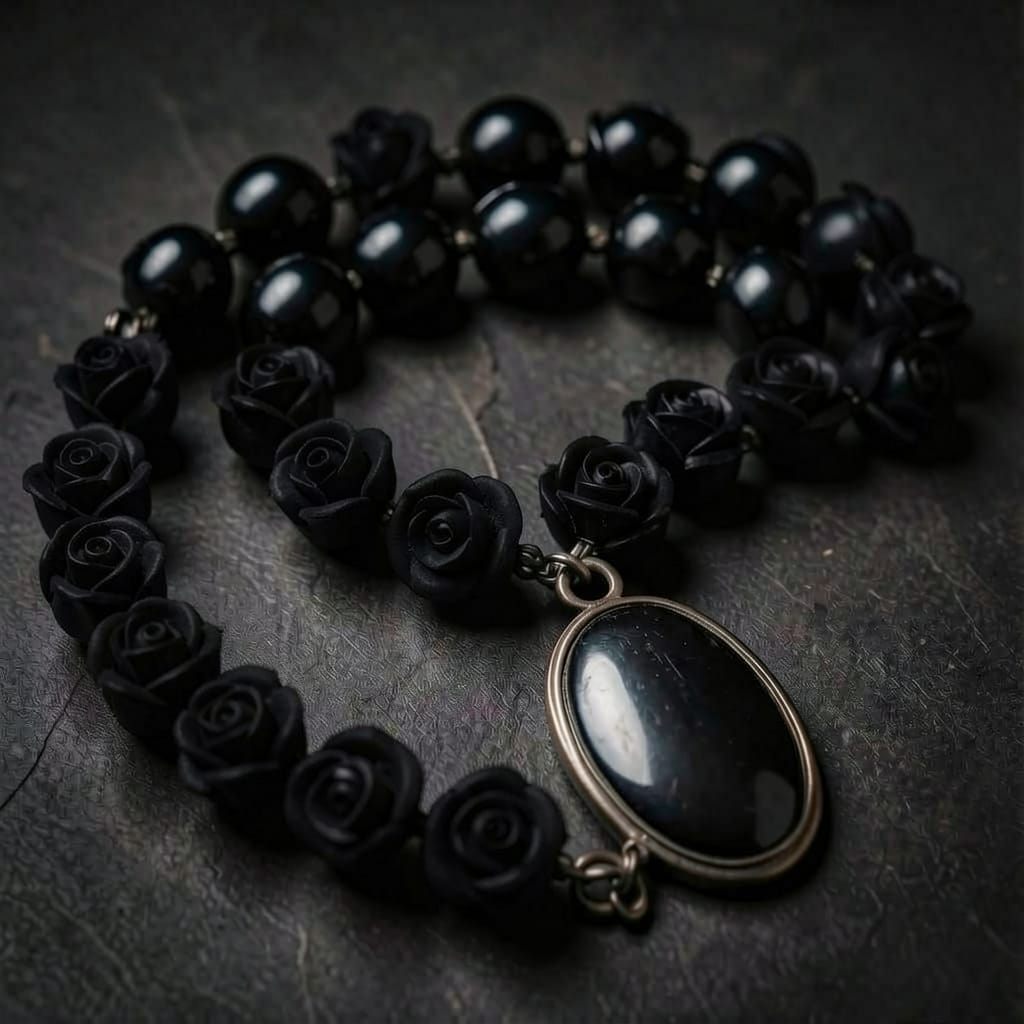
The oval medal at the end was a dark, liquid mirror, its surface polished to such a high luster it seemed to hold the shadows of the room. I turned it over, and there, shielded from the eyes of the world, were the initials MJD. They were inlaid in shimmering silver, the elegant, flowing script seated so perfectly into the fossilized wood that it appeared to have grown from the very grain.
Thomas looked up, his eyes reflecting a centuries-old understanding. He did not ask why the count was so short, nor why the name was hidden. He simply watched as I ran my fingers over the thirty one beads and roses—the sum of a life that had ended while ours continued.
“It is weighted," he murmured, handing me the piece, "for a man who has a great deal of praying—or remembering—left to do."
I embraced him heartily, and he smiled, with a dignity of a master and joy of an old friend, yet his blue eyes glistened with understanding.
“Lawrence, my friend,” he said quietly. “Losing one so young is an unbearable pain, but remember this: while time is never merciful to us, it is the best keeper of the eternally young who never truly die in our souls. Come again before this glorious century dies, to remember the days gone by.”
I promised to return, and thanking him again, departed—the black jet safely hidden in my waistcoat pocket, the silver initials pressed close against my heart.