

Rosa Domini
Stat rosa pristina nomine, nomina nuda tenemus. — Bernard of Cluny (adapted by Umberto Eco)

Chapter I: The Ruined Triumph
The sun over Rome was a blinding, tyrannical gold, reflecting off the white marble of the Palatine until the world seemed to ache with light. It was the morning of my Vicennalia, the twentieth anniversary of my rise to power. I stood at the summit of the great stairs, the Dominus in purple and gold, looking down at a sea of senators, generals, and the future lords of the Tetrarchy. This was my masterpiece: twenty years of blood and iron forged into a singular, unbreakable order.
Then, the sea parted.
A man ascended the steps. He did not march; he moved with a terrifying, steady grace that silenced the trumpets and halted the chanting of the crowds. I felt the breath leave my lungs as he came into focus.
It was Sebastian.
The reports had been absolute. My own archers had sworn he was dead—left as a pincushion for the crows on the Campus Martius. Yet here he was, defying the gravity of the grave. He was no longer dressed in the polished bronze of a Captain of the Praetorians. He wore white and red robes that seemed to catch the light and hold it, making the imperial purple feel muddy and dim.
He stopped a dozen paces below me. His eyes—the eyes that had watched over my sleep and followed me wherever I went—were bright with a conviction that made the sunlight seem like a pale imitation of the truth.
“Diocletian,” he said.
The name echoed against the marble, a sacrilege in the face of the gods. The crowd gasped; my guards shifted, their caligae scraping against the stone. To use my name was to strip me bare. He was not looking at the Emperor; he was looking at the boy from Illyria.
“You have spilled enough innocent blood to drown the city you claim to save,” he spoke, his voice carrying to the very back of the Forum. “You have built a kingdom of stone, but the Spirit is a fire you cannot quench.”
I felt the heat of a thousand stares. My anniversary—my twenty years of sacrifice—was being ruined in front of the future of Rome. He stood there, resolute and calm, while I felt the foundations of my dignity crumble. He wasn’t just a traitor; he was a mirror, and I hated the man I saw reflected in his gaze.
“Silence him!” I roared, my voice cracking with a desperation that betrayed my godhood.
As the guards swarmed forward to seize him, he didn’t struggle. He simply kept his eyes on mine—eyes full of pity and compassion. I turned my back on the sun, marching into the shadows of the palace, but I could still feel his gaze burning through my robes. The triumph was gone. The feast was ash. The man who would not die had just begun to kill the Emperor.
Chapter II: The Name Not Spoken
The guards had retreated to the mouth of the tunnel, their torches casting long, flickering shadows that danced like restless spirits against the damp stone. I watched them go, half-wishing I had the courage to tell them to keep walking—to leave me alone in the dark with the man I had once called my right hand.
I looked at Sebastian. The red and white of his robes were stained with the grit of the dungeon, yet he carried himself with a terrifying grace. I wanted to reach out and touch his shoulder, to feel the familiar weight of his muscle and bone, to prove to my racing heart that he was not a phantom.
“Why?” I whispered. My voice didn’t sound like the voice of the Dominus. it was thin, raspy, the voice of an Illyrian boy lost in a storm. “I gave you the world, Sebastian. I gave you my trust. I gave you the keys to my very life.”
He stood perfectly still. The stale scent of damp wool and old leather seemed to pull at the air between us. “You gave me a crown of dust, Diocletian,” he said softly. “I found a crown of light.”
I flinched as if he had struck me. “Do not call me that,” I hissed, stepping into his space. I could smell the bitter rust from the iron gate-hinges, a sharp, metallic tang that felt like a needle in my lungs. “I am your Lord. I am the Augustus. I am the reason Rome still breathes.”
“Rome is gasping,” Sebastian replied. He looked into my eyes—the eyes that had watched over my sleep, the eyes that had marched behind me from the Danube to the Euphrates. But they were different now. They were filled with an unbearable pity and compassion that made my skin crawl. “And you are the one strangling her, my friend. You think you are building a wall to keep the night out, but you are only building a tomb.”
“I am building order!” I roared, my hand flying to the iron hilt of my dagger. I felt the rough, oxidized cross-guard bite into my palm, the reddish grit of the rust flaking onto my skin like a pox. “I am the only thing standing between the world and the fire! I needed you, Sebastian. I needed my captain. My brother.”
My voice broke. For a second, the mask of the Emperor slipped, revealing the raw, bleeding disappointment underneath. I wanted him to see my pain. I wanted him to see the shattered belief that was currently tearing me apart.
“I was lost,” I confessed, the words falling like stones into the muck. “When they told me you were a Christian, I felt the foundations of the world crack. I thought... I thought if I killed the captain, I could keep the man. I thought the arrows would purge the madness from you.”
Sebastian stepped closer. He didn’t look at my dagger. He looked at the man holding it.
“You cannot kill the Spirit with iron, Diocletian,” he said, and the use of my name was no longer a weapon—it was an invitation. A plea for me to remember who I was before the purple silk turned my heart to stone. “You are tired. I can see it. You are the master of the world, and you have never been more afraid.”
I looked at his eyes—those calm, resolute eyes—and for a heartbeat, I wanted to fall to my knees. I wanted to ask him how to find the peace he carried.
But then I saw the guards watching from the shadows. I remembered the marble stairs, the Senators’ sneers, the 20 years of blood I had shed to become the Dominus. If I yielded now, I was nothing. If I spared him, I was a failure.
“I am not afraid,” I lied, the words tasting like ash. I shoved him back, the scent of wet wool and his own quiet grace suddenly repulsive to me. “I am the Law. And the Law demands that you break.”
I turned my back on him, my iron-studded boots clattering against the marble in a frantic, hollow rhythm. “Take him!” I screamed to the guards. “To the Hippodrome! I want the memory of his eyes ground into the dirt!”
As I marched away, I could still feel his gaze on my back—the eyes that had once watched over my sleep, now watching the slow, certain death of my soul.
Chapter III: Breaking Stone
The air in the palace gardens was thick with the scent of jasmine and the metallic tang of fear. I didn't want to watch. As Dominus, my word should have been the end of it, but Sebastian had turned my own garden into a courtroom. He stood there, his back to the very sun that was supposed to be my father, and spoke as if the guards weren't already unhooking the heavy wooden cudgels from their belts.
"You cannot break what was never made of stone, Diocletian," he said. His voice was steady, despite the jagged scars of the arrows that still pulled at his skin.
I felt a sudden, bone-deep weariness wash over me—a fatigue that the purple robes could no longer hide. It was the weight of twenty years of holding the world together by its throat. I was tired of blood, tired of miracles, and most of all, tired of the way this man looked at me. I couldn't bear to have this finished in the privacy of a cell or the quiet of a garden. I wanted the scale of the architecture to swallow his defiance.
"Take him to the Circus on the Palatine," I commanded, my voice sounding hollow even to my own ears. "If he wishes to be a spectacle, let the stone seats of the Caesars witness his end."
The procession to the Palatine Circus felt like a funeral march for a ghost. As we entered the arena, the shadows of the high walls stretched across the sand like reaching fingers. I sat in the imperial box, looking down at the small, solitary figure in the center of the vast oval. The emptiness of the stands only made the space feel more oppressive.
"Break him," I whispered, the command barely leaving my lips. "Break every bone that refuses to kneel."
The first blow landed with a sickening, hollow thud—the sound of wood meeting a human rib. The few courtiers present gasped, a collective intake of breath that sounded like a dying fire. Sebastian didn't scream; he let out a sharp, rhythmic grunt of air, his feet sliding back against the sand but never leaving the earth.
The soldiers moved in a practiced circle, their clubs rising and falling like the hammers of a forge. Each strike was a "breaking of stone"—the sound of an empire trying to crush a soul it couldn't understand. I watched his white and red robes bloom with a new, darker red. He was becoming a ruin, yet his eyes stayed fixed on mine, clear and unclouded by the agony.
"Do you... feel it... Caesar?" he gasped between the blows. "The more you strike... the brighter the fire... becomes."
It was a massacre in slow motion. The soldiers were sweating, their faces twisted in a strange, growing desperation. They were the ones who looked defeated, exhausted by the sheer effort of killing a man who seemed to accept every blow as a gift. Finally, with a sound like a snapping branch, his legs gave way. He fell, not like a victim, but like a seed being planted in the dirt.
"Enough," I said, my weariness turning into a cold, hard stone in my chest. "Throw him in the Cloaca Maxima. Let the filth of Rome swallow its greatest traitor."
As they dragged his broken body away, the sand of the Circus was stained with a trail that looked like a path. I stood alone in the imperial box, the sun finally setting behind the Aventine, and for the first time in twenty years, I felt truly old.
Chapter IV: The Eye of the Sun
The return to the palace was a descent into a silent, marble throat. The transition from the open air of the Circus to the enclosed stone of the Palatine Hill felt like being buried alive in the weight of my own authority. The air inside was thick with the scent of guttering oil and the cold, damp draft rising from the lower levels—a reminder that I had cast the heart of my Praetorians into the Cloaca Maxima.
I dismissed my attendants with a jagged snarl. I wanted the silence of a god, but I found only the hollowness of a ghost. When sleep finally claimed me, it was not a mercy. It was a shattering.
In the dream, Rome was a city of glass under a sky of liquid fire. I stood atop the Capitoline, but the foundations were groaning. With a sound like a thousand snapping bones, the white marble began to fracture. The columns of the Forum didn’t just fall; they disintegrated into a choking white dust that tasted of lime and death. My masterpiece, the Tetrarchy, was being ground to powder by a force I could not name.
I looked up to the heavens, seeking the favor of Jupiter, but the sky had been replaced.
A sun of tyrannical, impossible gold hung at the zenith—but it was not a star. It was an eye. A colossal, lidless orb that filled the horizon, burning with a light that made the imperial purple turn to ash. It was the eye of Sebastian. It watched me with a terrifying, unblinking clarity that stripped the skin from my soul. Under its gaze, the ruins of Rome didn’t just crumble; they began to glow with an internal, white-hot fire.
“You have built a kingdom of stone,” the wind roared, sounding like the voice of a furnace. “But stone is only a shadow of the Spirit.”
Every fragment of the city—the broken arches, the shattered statues of the gods, the very dust of the streets—began to vibrate with the frequency of that golden gaze. The sun-eye of Sebastian descended, its heat peeling the divine status from my body until I was nothing but the boy from Illyria, shivering in the ruins of a world I had broken while trying to save.
I reached out to steady myself against a wall, but the stone turned to light and slipped through my fingers. The world was no longer solid; it was a conflagration of truth, and I was the only thing standing in the dark.
Chapter V: The Fragrance of the Void
The nightmare was too large for the room. I could not breathe beneath the weight of the Palatine’s stone, so I shed the purple. In a simple tunic of rough wool, I slipped past the guards like a shadow escaping its master. I was the Dominus, the architect of the world, yet I was skulking through the alleys of my own capital, drawn by a morbid gravity to the mouth of the Cloaca Maxima.
I reached the place where the city’s filth emptied into the Tiber. The air was a thick, physical rot, a soup of offal and human waste. I wanted to see him—to see the broken, muddy reality of the man who had dared to blink like a sun in my dreams. I wanted the stench to prove he was only meat.
My foot slipped on the slick, black stones of the embankment. I fell, my hands plunging into the cold, viscous mud. I stayed there, on my knees, the Emperor of Rome reduced to a crawling thing in the dark. I looked into the swirling, stinking water, searching for a flash of white and red, but there was only the void.
“You are nothing,” I hissed into the muck.
Then, the world shifted.
The stench of the sewers vanished, sliced through by a sudden, impossible gust of wind. It didn’t smell of the Tiber; it smelled of high mountain meadows, of crushed thyme, and the honeyed sweetness of blooming lilies. It was a fragrance so pure it felt like a physical blow to my chest. It brushed against my cheek, warm and deliberate, like a hand offered in the dark.
“Sebastian?” I whispered, my voice cracking.
The wind was gone as quickly as it had come, leaving me alone in the rot. I scrambled back to the palace, my heart hammering a frantic rhythm against my ribs. I threw myself onto my bed, still stained with the mud of the river, and let the darkness drown me. For the first time, I didn’t fight the sleep. I let it take me like a tide.
I woke to a silence so profound it felt like the world had ended while I slept. The morning sun was a pale, thin silver. I turned my head on the pillow and froze.
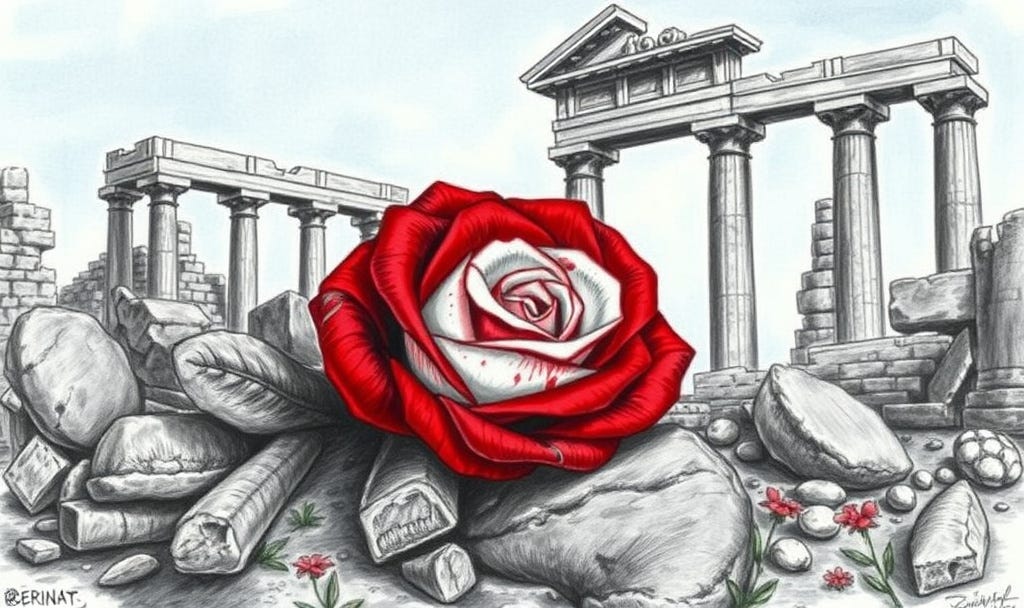
There, resting on the silk where no servant could have placed it, was a single red rose. Its petals were a deep, arterial crimson, but its center—its heart—was a blinding, snowy white. I reached out, my hand trembling, and pressed my thumb against the stem. A thorn, sharp as a Mauritanian arrow, pierced my skin.
A single drop of blood bloomed on my thumb, matching the red of the petals.
The weight of twenty years, of every execution, every border war, and every lie I had told to keep the sun in the sky, finally broke. I didn’t sob; the tears simply fell, hot and silent, washing the Illyrian dust from my face. I looked at the rose—the white and the red—and I knew. The Great Persecution was over, because I was the one who had been conquered. The end was not coming; it was already in the room.
Chapter VI: The Throne of Ash
The morning was a jagged blade of light. I sat on the throne, the Great Seal of the Tetrarchy heavy in my lap, but I felt as light as the ash in a brazier. My thumb, where the thorn had pierced it, throbbed with a rhythmic heat that seemed to synchronize with the pulse of the city outside.
When Galerius entered, his boots thundering against the marble, he stopped dead. He didn't see the god-emperor; he saw a man whose eyes were red-rimmed and whose hands were stained with the black mud of the Tiber.
"Caesar," he began, his voice wary. "The purges in the Subura continue. We have found more of the 'Light-bearers.' We await your order to—"
"No more," I said. My voice was a whisper, yet it cut through his bravado like a sickle.
"No more?" Galerius stepped forward, his hand resting on the hilt of his spatha. "The boy from the Circus... he was a sign. If we do not crush this fire now, it will consume the Palatine itself."
I looked down at the single red rose I had hidden in the folds of my sash. Its scent was still there, faint and haunting, a mountain wind trapped in a room of stone. "The fire has already consumed the Palatine, Galerius. You are just too blind to see the smoke."
I stood up, the purple robes sliding off my shoulders as if they no longer fit the shape of my soul. I looked at my reflection in the polished bronze of a nearby shield. I looked old. I looked human. I realized then that my Vicennalia was not a celebration of twenty years of power, but a funeral for the man who thought he could rule the Spirit with iron.
"Prepare the edict," I commanded, turning my back on him. "We are leaving Rome. I am going to Salona. I wish to grow cabbages while the world I built burns."
The journey from the Palatine Hill felt less like a departure and more like a retreat from a battlefield I had already lost. As my carriage rattled over the stones of the Via Appia, I did not look back at the spires of Rome. I could still feel the weight of the red rose—now withered but still potent—pressed against my chest beneath my tunic.
Chapter VI
The Road to Oblivion
The city walls faded into the morning mist, but the silence inside the carriage was absolute. My guards, the Illyrian cavalry, rode in a grim circle around me, their faces set in stone. They had seen me defy kings and crush usurpers, but they did not know how to protect me from a fragrance or a dream. Every jolt of the wheels sent a spark of pain from my thumb, where the thorn had struck, reminding me that even an Emperor’s blood is just salt and water.
"Why do we hurry, Dominus?" a young officer asked during a change of horses. He looked toward the horizon, perhaps expecting a Persian army or a Germanic horde.
"We are not hurrying toward something," I replied, staring at the dust on my boots. "We are fleeing the shadow of a man who refused to stay in the earth."
We moved toward the coast, toward the massive limestone walls of Diocletian's Palace in Split. I had built it as a fortress for my old age, a masterpiece of Tetrarchic architecture, but now it felt like a magnificent tomb. As we crossed the mountains, the air grew sharp with the scent of the Adriatic, yet my mind kept returning to the herbs and flowers of the Cloaca Maxima.
I closed my eyes and saw the shattering Rome again, the sun with Sebastian’s eyes watching me. I realized that my abdication wouldn't be an act of statesmanship, but an act of surrender. I was leaving the throne before the Light burned me out of it. By the time we reached the gates of Salona, I was no longer a god. I was a gardener, waiting for the winter.
Chapter VII: The Journal of a Dying Sun
The Ninth Day before the Kalends of June,
Palace of Salona
The salt air of the Adriatic is supposed to cleanse. Instead, it only preserves the rot.
I sit here, overlooking the cabbage patches that the world mocks, and realize that abdication is not a release—it is a mirror. In Rome, the noise of the crowd drowned out the sound of my own conscience. Here, in the silence of Dalmatia, the silence screams.
News arrived today from the East. Galerius—the man I hand-picked, the man to whom I gave my own blood by marriage—has shed the last of his humanity. I thought his fire would protect the Tetrarchy; I did not realize he was a furnace that would consume everything I loved.
I see the reports of his "purges," his obsession with the Christians, his erratic rages. And my heart sickens for my daughter, Valeria. I wed her to a beast in the hope of taming a wolf for the State. Now, she is trapped in his lair, her letters growing shorter, colder, and more desperate. I have traded my only child for a political stability that didn't even survive my first year of retirement. Maximian has laid down the purple too, but he is already restless, his hands itching for the sword. He does not understand what I saw in that Circus on the Palatine. He did not see the man who would not die.
The Seventh Day before the Kalends of June
The dreams have changed. They no longer smell of the Cloaca Maxima.
Last night, I saw Sebastian again. He was standing in a place of deep, cool darkness—a cavern of bones. He wasn't bleeding. He was simply waiting. He held a shovel, and he was digging a grave, but not for himself. He was digging it for the Tetrarchy. Each shovelful of earth he threw back into the sun turned into a spark of light.
I realize now that the reports from the Appian Way are true. They say Lucina found him. They say he was buried in the dark, yet the Christians go there not to mourn, but to gather strength. While the four of us—Maximian, Galerius, Constantius, and I—tear the world apart trying to hold it together, the dead Captain of the Praetorians is unifying the city from beneath the soil.
The Third Day before the Kalends of June
My thumb throbbed today where the thorn pricked it. The wound has healed, but the mark remains—a tiny, pale star on my skin.
I looked at it and wept. I, Diocletian, who restructured the world, cannot even save my daughter from the husband I chose for her. I am the architect of a prison. I look at the white and red of the mountain flowers in my garden, and all I see is the rose. All I see is the blood on the marble.
I fear that when I die, the history books will say I saved Rome. They will be wrong. I only built the walls higher so I wouldn't have to see the Spirit burning them down. Sebastian is more of an Emperor in his tomb than I am in this palace.
The Eleventh Day before the Kalends of December. Or is it the twelfth? The sun is a pale, diseased eye, staring through the colonnade.
The messengers. They are like crows, landing on my peristyle with their black-sealed scrolls, their faces ashen, as pale as the ghosts that pace my bedside. I cannot open them. I touch the wax and it feels like the warm, sticky skin of a fresh corpse. My fingers, once used to signing the fate of nations, now tremble so violently the reed snaps.
Galerius. My son-in-law. My monster. The reports—I read them in the flickers of the oil lamp before I scream and cast them into the brazier, but the words remain burned into my retinas. He has gone mad with the sickness, his body rotting while he still breathes, a living Cloaca Maxima. But it is what he has done to them. My wife, Prisca. My daughter, Valeria.
The ink on the parchment runs, blurred by my own sweat, or perhaps the walls are weeping again. Exiled. Stripped. Hunted. I see Valeria in the corner of my eye—pale, pale, a shimmering reed in the dark, her face a hollow ivory mask. She is wandering the deserts of the East, her imperial robes torn into bandages for her bleeding feet. I gave her to him! I gave her to the wolf to save the Tetrarchy, but the Tetrarchy is a beast that eats its own heart. I am the father who traded his child for a handful of salt and dust.
I cannot face the reports. I cannot face the truth. When the guard brings the next scroll, I see the name of Sebastian written in the margins of my mind, a ghost-script that mocks my laws. They say the Christians are multiplying in the shadow of my daughter’s suffering. They say for every drop of blood Galerius spills, a white and red rose blooms in the dark.
Suffocating. The air in Salona is too thick, heavy with the scent of the sea and the iron tang of the blood I cannot wash away. I look at my cabbages—those pale, round heads in the dirt—and I see the faces of my family, staring back at me from the muck. I see the arrows. I see the clubs. I am the architect of a world where everything I love is being broken like stone.
The light is coming back. That pale, blinding Sebastian-light. It’s leaking from the scrolls. It’s burning through the marble. I am a god of ash, kneeling in a garden of phantoms, waiting for the dark to finally—
Chapter IX: The Keeper of the Light
"I found him where the world discards its shame, but I only knew where to look because the dead do not sleep as soundly as the living.
For three nights, the dreams came—not as shadows, but as seizures of light. I saw him standing in a place of rushing, black water, his body a map of silver scars. He did not speak with words; he spoke with a fragrance that pulled me from my bed. In the dream, he pointed to the Cloaca Maxima, the great throat that swallows the sins of Rome. I saw his hand, pale as a lily, rising from the filth, and I knew the Emperor’s second execution had failed to bury the truth.
The Tiber is a graveyard of secrets, and it was there, amidst the offal, that the soldiers thought they had hidden the Spirit. They used the blunt weight of iron and wood this time, wanting to ensure there was no beauty left to recognize. When we pulled Sebastian from the mire, he was a ruin—shattered, cold, and heavy with the silt of the city.
But as we carried him into the deep silence of the Appian Way, the miracle began.
Down here, in the tufa stone, the breath of the living is usually thin, smelling of damp earth. But as I laid him upon the slab, the rot of the sewers simply... vanished. It was sliced away by a sudden, impossible wind. It was the fragrance of mountain thyme crushed underfoot, of flowers blooming in a frost.
'He is dead,' my servants whispered, their faces pale with terror. 'The Emperor has won.'
'No,' I told them, for the light was already blooming. It did not come from my lamp. It came from the wounds. The gashes where the clubs had broken the bone began to glow with a soft, silver luminescence, like moonlight trapped in alabaster. The deeper we went into the catacombs, the fresher the air became.
The miracles followed like ripples. The blind touched the shroud and saw the white-hot center of a rose. The sick drank the air and felt the fever break. We did not bury a corpse; we planted a sun.
I hear the whispers from the East—rumors of Valeria wandering the wastes, a princess of shadows, and of her father, the great Diocletian, rotting in his palace of stone at Salona. They say he is suffocating. He does not understand that he tried to break the stone, but he only released the light. Sebastian is still, his eyes are closed, but the fragrance of his victory is already turning the Emperor’s world to ash."
Chapter X: The White Harvest
The night in Salona was no longer made of air; it was made of lead. I lay in the center of my bedchamber, the Dalmatian coast whispering against the cliffs below, but I was back in the mud. I was always back in the mud.
My lungs felt like parched leather, cracked and failing. I reached out for the nightstand, for the crown that wasn't there, for the wine that tasted like gall. The reports of Valeria's wandering, the news of Galerius's rot—they were no longer scrolls. They were weights, piled upon my chest until I could no longer draw a breath of Roman air.
Then, the window blew open.
There was no storm, no gale from the Adriatic. Instead, the room was suddenly flooded with the impossible. The stench of my own aging, the smell of the oil lamps, the very scent of the stone—it all vanished. In its place came the mountain thyme, the sharp, cold sweetness of lilies, and the overpowering, heart-stopping fragrance of a thousand crushed roses.
I saw him.
He did not walk; he was simply there, standing at the foot of my bed, emerging from the pale. Sebastian. He was no longer the ruin of the Circus. He was whole, his skin glowing with the translucent light of a star seen through mist. He wore the white and red robes from my first nightmare, but they were no longer stained. They were the source of the light.
He reached out a hand—the hand I had ordered broken, the hand I had seen cast into the filth.
"The harvest is over, Diocletian," he said. His voice wasn't a sound; it was a vibration in the marrow of my bones.
I looked at my own hand—the one that had held the world together by the throat. It was pale, so pale, translucent and trembling. I saw the mark of the thorn on my thumb, glowing with the same silver fire as his scars.
"Valeria..." I gasped, the name a jagged fragment of glass in my throat.
"She is in the Light," he answered, and for the first time, the pity in his eyes didn't burn. It healed.
I felt the stones of the palace dissolve. The walls of Salona, the map of the Tetrarchy, the blood of the purges—they all turned to white dust and blew away on that sweet, herbal wind. I wasn't an Emperor. I wasn't a god. I was the boy from Illyria, standing in a field of flowers that smelled of home.
I reached for his hand. My fingers brushed the light, and as the last of the Roman dark swallowed my eyes, I finally found a breath that didn't hurt.
The legend of Diocletian and Sebastian serves as the ultimate study in the friction between temporal power and spiritual endurance. While the prose captures the psychological collapse of the Dominus, history provides a grimly symmetrical conclusion to the players of the Tetrarchy.
Diocletian’s End: He died in 311 or 312 AD, arguably the only Roman Emperor to die of "despair." He witnessed his political system shatter into civil war and was unable to save his wife, Prisca, or his daughter, Valeria, from the vengeful purges of his successors. His magnificent Palace in Split became his tomb, and in a final historical irony, his mausoleum was later converted into a Christian Cathedral, purging his memory from the very stone he laid.
The Fate of the Family: Galeria Valeria and Prisca were eventually hunted down and executed by Licinius in 315 AD. Their bodies were thrown into the sea, a tragic echo of the Emperor's own command to discard Sebastian into the Cloaca Maxima.
The Rise of Sebastian: The "man who would not die" became one of the most enduring figures in Western art and hagiography. His primary burial site, the Catacombs of San Sebastiano, became a major pilgrimage hub. By the time of Constantine’s Edict of Milan in 313 AD, the "Spirit" Diocletian feared had effectively conquered the Roman Empire from within.
The transition from the Iron of Rome to the Faith of the Martyr was complete. The Emperor’s house was built of stone that crumbled, while the Captain’s legacy was built of a light that survived the dark.
This is absolutely brilliant work - truly Hell!
It feels timeless, as if written ages ago and carefully delivered for today.