

The Delorme Way
France is ravaged by plague, and all ways have been tried. Doctors are desperate.

France, November 1347.
It arrived swiftly, quietly, like a cat hunting a nervous mouse. The ships had docked, the people came down, and the sky darkened. That is how it began.
First came the weakness, then the rash, and finally, on the third day, the bulbs, like those of posies. Hidden they festered and grew, under the arms, in the skin folds where nobody noticed, until the whole body resembled a flowerbed. Only, instead of flowers, there was the feverish, hellish agony—and the things the Italians called the bubos.
In a month, the streets of the south were empty. People died in droves, and the doctors panicked. Some succumbed, some fled, and with them, left the sickness—to nest in different places.
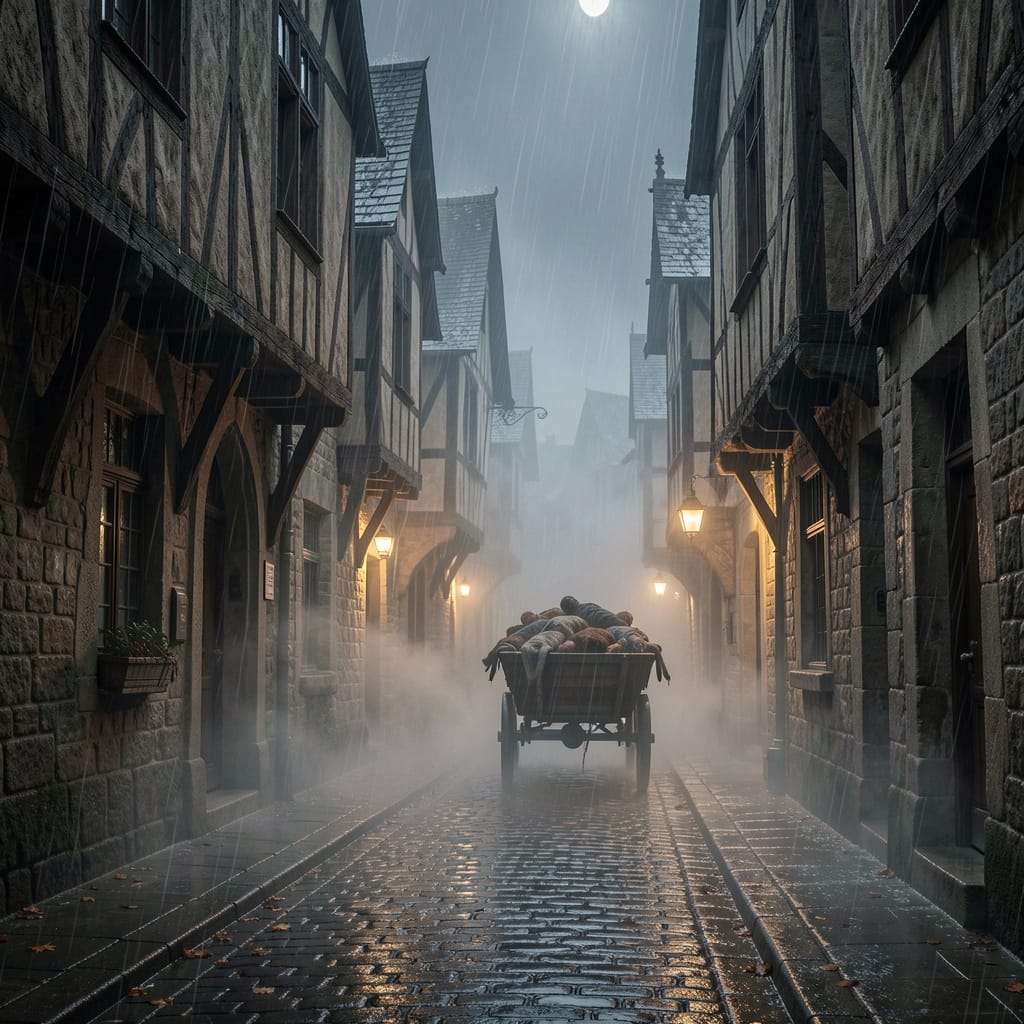
By the summer of 1348, it reached Paris. Here it became volatile, cruel, reaping souls and bodies by hundreds a day. The Parisian medicine, with all its knowledge, wasn't swift enough. Neither was it good enough, it seemed. Soon enough the mort bell, gasps, and cries drowned out the sound of life. The streets died out, like a dead man's arteries, and there was nothing that could stop the drying out, the shriveling of the corpse that was once Paris. And there was no embalming fluid that could substitute the poison running through that rotting body.
The poison did not stay confined to the streets. It leaked into the Faculty itself, creeping up the damp stone stairs until it pooled in the stone chamber where the desperate calculations were made.
Inside, the air was a thick, unbreathable soup. A massive hearth blazed in the corner despite the warmth of the season, kept stoked with green oak and bitter resin because the academic manuals dictated that extreme heat could crack the pestilential air. The windows were heavily shuttered and sealed with thick strips of lard-soaked felt, trapping the scent of unwashed wool, stale sweat, and the sharp, vinegar-sting of the mixtures they used to wash their hands. The candles burned low, casting long, frantic shadows that danced like demons against the soot-stained rafters. On the massive oak table, the ancient books lay open—Galen, Hippocrates, Avicenna—their pages warped by the humidity and stained with the desperate, oily wax of late-night calculations.
Master Jean wiped a hand over his eyes. At barely thirty-four, he was the youngest master in the Faculty, a man whose hair was still thick and dark, though now matted with sweat beneath his linen cap. He had spent his twenties consuming texts, rising rapidly through the ranks of the university on the back of his fierce intellect and unshakeable confidence. But now, the skin of his face felt tight and dry from the hearthfire, his youthful features haggard and stained gray with fatigue. His knuckles—smooth, strong, and unmarred by the arthritis that plagued the older doctors—were sticky with the paste of crushed lilies, dried toad skins, and pig fat. It was a mixture he had spent the last three hours grinding in a heavy bronze mortar until his young shoulders screamed with pain.
"The humors are boiling," he croaked. His voice, usually a sharp, resonant baritone that commanded the lecture halls, sounded raw and scraped open from inhaling the dense columns of frankincense and sulfur meant to kill the bad air. "We must adjust the balance. If we lance the bulbs at the precise moment of their ripening, we can draw the malignant fluid before it corrupts the heart..."
"And they die faster than the fever can take them," Master Simon interrupted. He didn't just speak; he slammed his palm onto the parchment, the force of the blow rattling the inkwells.
Simon looked like a ghost beside the young doctor. His eyes were sunken into dark, bruised hollows, his frame withered by despair and a lifetime of academic isolation.
"We have bled them from the arm, the leg, the neck," Simon whispered, his anger collapsing into a terrible, flat exhaustion as he looked at Jean's stubborn, youthful face. "Do you not remember the butcher’s son on the Rue Saint-Denis? We opened the median vein just as Galen prescribed. I watched the blood flow into the basin—it was dark, thick, smelling of old iron. We took only eight ounces, Jean. And the boy’s pulse fluttered and died before the bandage was even tied. We used leeches until the creatures bloated, turned a sickening shade of purple, and died from the very rot they were meant to suck out. It does not balance the body. It just drains the remaining life out of it, leaving them too weak to fight the fire in their blood."
"Then the heavens," a younger cleric whispered. He was tucked away in the shadow of the hearth, his fingers trembling as he clutched a complex astrological chart. His fingernails were bitten down to the quick. "The great conjunction of 1345. Saturn, Jupiter, and Mars in the three-bodied house of Aquarius. The deadly alignment drew up the toxic vapors from the belly of the earth. The air itself is unmade. We must calculate the exact hour the moon leaves the square of—"
"We blamed the stars months ago!" Simon snapped, turning on the young man with a venom that made the cleric flinch. "We wrote the letters. We sent the scrolls to the Louvre. We told the King the air was corrupted by the heavens. We told Paris to burn aromatic woods, to shutter the windows, to carry perfume. And what did they do? Now the city is a suffocating smog of smoke and lavender, the air is so thick a man can taste the pitch on his tongue, and the carts are still piled to the sky. The stars do not care about Paris, boy."
Silence fell, heavy, hot, and suffocating. Through the heavy wooden shutters, the distant, rhythmic tolling of the mort bell leaked into the room, a dull clang-clang that seemed to vibrate through the very flagstones beneath their boots.
Jean looked down at the table, his eyes tracing the final ink strokes on the list of everything they had tried. For a man in his thirties, who had believed his entire life was ahead of him and that science could conquer any foe, the ink was a dark, mocking archive of human failure.
He remembered the smell of the theriac—the expensive treacle mixed with sixty-four separate ingredients, including the dried flesh of vipers. They had forced it down the throats of dying merchants, only for the patients to violently vomit it back up, their bodies rejecting the luxury cure. He thought of the liquid gold, a remedy that cost a king's ransom, administered in tiny, precious drops to a wealthy Countess. Simon had held the silver spoon to her lips, watching the gold leaf shimmer in the candlelight, but the poison inside her didn't care about wealth; her tongue had turned black anyway, and she was dead by sunrise.
Then there were the cruder things. The compresses of figs, yellow dung, and cooked onions pressed tightly into the hot flesh folds of the groin and armpits. They had hoped to force the buboes to "bloom" like boils, believing that if the swelling burst outward, the body would be saved. Instead, the poultices had only scalded the skin, causing the patients to scream in agony as the flesh turned to liquid beneath the bandages, releasing a stench so foul that even the hardiest sisters of the Hôtel-Dieu had fainted.
They had forbidden baths, terrified that the warm water would open the pores of the skin and invite the invisible, floating miasma into the vulnerable depths of the body. They had restricted diets, banning fruit, fish, and young meats. They had ordered the city to pray until their knees bled and their voices failed.
And now, the ink was dry, and the list was finished. They had tried everything.
The realization did not hit Simon with terror, but with a cold, hollow emptiness that seemed to chill the hot room. He looked at the rows of leather-bound volumes lining the stone walls. The ancient books suddenly looked like nothing more than painted goat skin and useless scribble, the dead thoughts of dead men who had never seen a horror like this. The knowledge of a thousand years, the pride of the greatest university in Christendom, completely hollowed out by a single, unseen wind.
"There is nothing left," Simon whispered. His voice didn't echo. The heavy, stagnant air of the chamber swallowed it whole. "We have exhausted the Greeks, Jean. We have exhausted the Arabs. We have used the fire, the steel, and the herbs."
He reached out and slowly closed the heavy leather cover of Avicenna's text. The brass clasps clinked shut like a coffin lid, and a small cloud of ancient dust rose from the binding, settling lazily into the flickering candlelight. "Our satchels are empty. We are not practicing medicine anymore. We are just watching the world dry out."
Jean did not answer. He couldn't. He just stared at his own knuckles, at the crust of dried herbs beneath his fingernails. He was a young man, built for life, but he was realizing that the medicine of Paris was just another form of rot, waiting for its own bell to toll.
Then, Jean's eyes flashed. The sluggish, heavy despair of the room seemed to bounce off his stubborn youth, replaced by a sudden, frantic electricity.
"I am going to perform my duty until I beat this foul thing, or until it kills me," he announced. He ripped the sweat-soaked linen cap from his dark hair, throwing it onto the table where it slid across the useless astrological charts. "You can stay here all you like, rotting in your own shadows, but I won't let fear stop me. I did not master this craft, nor spend ten years bleeding over text, just to sit and tremble while the pestilence ravages my city. Valete, magistri."
He spun on his heel, his heavy wool scholar's robes snapping around his ankles, and departed. The heavy oak door slammed shut behind him, the force of it vibrating through the stone walls and causing the guttering candle flames to dance wildly.
"Has he gone mad?" Simon whispered, his voice cracking. He stared at the blank wood of the door. "He'll drop dead in the gutter before midnight, and we will be even more short-handed."
"We already are," said Master Etienne grimly, speaking for the first time that day. He didn't move from his spot, his heavy frame casting a massive, unmoving shadow against the damp stone wall. His gaze remained fixed on the empty doorway. "But he is proud, all right. The boy still thinks his youth makes him immortal."
"Pride is sinful," the young priest said, stepping forward from the darkest corner of the room. He crossed himself with a sharp, tight movement, his knuckles white. "The Lord punishes the proud. He breaks the stiff neck of the arrogant."
The doctors scoffed, a bitter, synchronized sound of disgust. They had stopped believing in the mercy of the liturgy weeks ago, yet under normal circumstances, they never dared to oppose a servant of the Church openly. The university was bound to the Bishop, and the shadow of the Inquisition was never far from men who questioned divine will. The priest sensed their silent rebellion. Raising his eyes to the soot-stained timber ceiling, he began to chant his favorite litany, his voice rising in an artificial, reedy sing-song meant to drown out their doubt.
"Pity us, Saint Anthony,
Pray for us, Saint Sebastien,
Pity us, Saint Laurent,
Have mercy on us,
Sweet Lord..."
The tension in the stifling room became heavy, thick, and physically palpable, vibrating alongside the distant tolling of the mort bell outside. Finally, an exhausted, rake-thin doctor named Edouard, who had sat in absolute silence for hours, stood up. His movement seemed to shake the very foundations of the quiet room. He slowly walked across the flagstones, stopping less than a foot from the young priest. Edouard was a tall man, towering over the priest, who looked like a child frightened of the headmaster. Edouard's eyes were wide and bloodshot, and his voice was terrifyingly cold when he spoke.
"Listen to me, Father," he growled, his voice a low, gravelly rasp that hacked through the priest's chanting. "With all due respect to your robes, I don't think God cares. Take your empty litanies elsewhere. God has turned His face from us."
"How dare you..." the priest gasped, taking a step back, his hand flying to the heavy silver crucifix resting on his chest. "This is sacrilege! This pestilence is the payment... the righteous punishment for the sins of the Parisians! The pride, the luxury, the filth of the streets—"
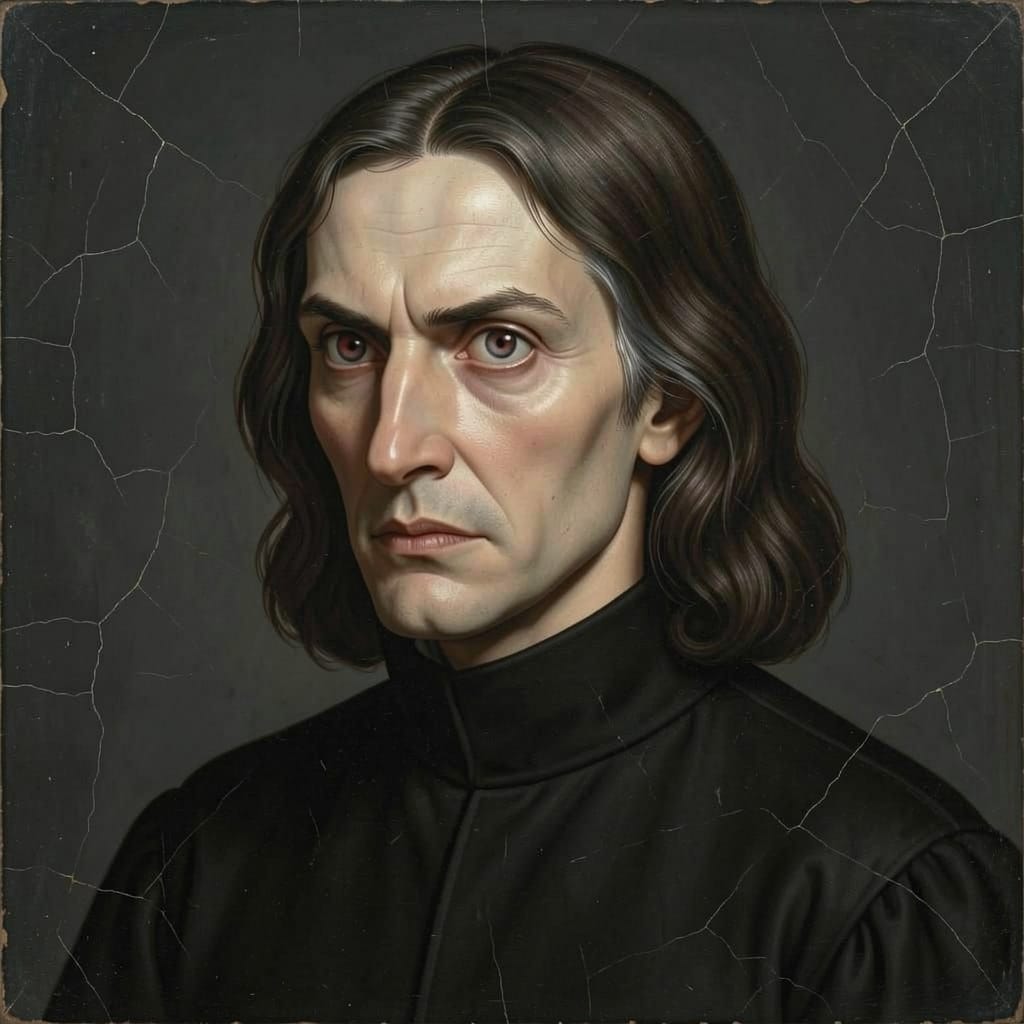
"Sin? Do you really believe that, Father?" Edouard interrupted, half mockingly, half incredulously. He leaned in closer, forcing the priest to smell the stale vinegar and dried toad paste on his breath. "What sin did my daughter commit, then? Tell me. She was five years old. She knew nothing of luxury. She knew nothing of the world's filth. She spent her days playing with wooden blocks and chasing the alley cats."
The priest opened his mouth to offer a standard theological defense, but Edouard’s voice cut him down like an axe.
"Or Philippe’s sons?" Edouard demanded, pointing a trembling, ink-stained finger at the sandy-haired doctor across the room. "Two boys, dead in the same bed, their bodies black before the sun set. Or Olivier’s young wife, expecting a child, rotting in the earth with a life still un-born inside her? Tell me, Father, what monstrous sin did a five-year-old child commit to deserve a death where her skin splits open and she suffocates on her own blood?"
The priest, confronted by the raw, bleeding meat of human grief, fell silent. His lips moved, but no sound came out. He looked down, unable to hold the old man's furious, weeping gaze.
"You don't know, do you?" Edouard sighed, the anger suddenly leaking out of him, leaving only a bitter, hollow husk. "Of course you don't. Your books have as few answers as ours. We have lost faith, Father. And I doubt we will ever regain it. So take your prayers to the streets, to those who still believe they can buy their lives with beads and bent knees. We have no use for saints where science is powerless. Go, Father. Leave us to our damnation."
The priest didn't answer. He turned and darted out of the room, his sandals clicking frantically on the stairs as if he were fleeing a room full of lepers.
Edouard slumped into a heavy oak chair, his chest heaving under his stained gown. He buried his face in his hands, his shoulders shaking with a silent, dry weeping that produced no tears.
"It was very... brave, Edouard," Simon said softly, stepping forward and placing a hesitant hand on the older man's sharp shoulder.
"It was," Philippe echoed, his voice thick with the memory of his own lost boys.
"We are doomed now," Simon croaked, turning his head to observe the stormy skies through the narrow, felt-sealed window. "Now the Church will turn against us."
The silence that followed was different from the academic despair of failed science from earlier. It wasn’t the frustration of useless books, but the cold, sharp isolation of men who had just cut their last safety line in a storm.
"The Church was always against us, Philippe," Edouard muttered into his palms, his eyes finally looking up at the gray, roiling clouds pressing down on the Faculty windows. "They just preferred us quiet. They liked us when we used their Latin to justify their miracles. Now we have given them a voice to blame, an enemy to point at for the graves we cannot fill."
Simon walked back to the oak table, his hand brushing against the closed leather binding of Avicenna. The gold leaf on the cover was flaking, peeling away under his thumb like the dead, blackened skin of the miserable souls in the overcrowded wards of the Hôtel-Dieu.
"If the Bishop hears of what was said here, the Faculty will be boarded up, our licenses will be stripped, and we will be branded heretics before the week ends," Simon whispered.
"Let them board it," Etienne said grimly, leaning his heavy frame back against the stone wall, his arms crossed over his chest. "What are we protecting? Empty lecture halls? Books that contain nothing but ancient lies? Jean at least has the dignity to go out and face the monster with his bare hands. We are just sitting here waiting for the roof to fall on our heads."
"Jean is an idiot," Simon snapped, though the venom in his voice lacked any real conviction. He began to pace the length of the chamber, his heavy boots clicking sharply on the cold flagstones. "He thinks his youthful pride is armor. He thinks because he wears the academic robe, the miasma will respect his pedigree and turn away. By tomorrow morning, his young name will be just another stroke of a quill in the parish register, buried under a foot of lime."
Outside, the storm finally broke.
A sudden, violent gust of wind rattled the heavy iron hinges of the shutters. The lard-soaked felt tore away with a sharp rip, forcing a heavy spray of cold rain across the table, immediately blurring the dry ink of their useless remedies and washing away the list of things that had failed. Nobody moved to close it.
The damp air that rushed into the suffocating room didn't smell like the fresh, cleansing rain of autumn. It smelled of the river. It smelled of the mud, the open, overflowing trenches at the Holy Innocents cemetery, and the thousands of bodies turning to liquid beneath the Parisian soil.
Edouard let out a hollow, dry laugh that sounded like cracking parchment. "Doomed," he repeated, looking up at the timber ceiling as if he could see through the stone to the heavens he no longer believed in. "We survived the great famine. We survived the wars with the English. And now Paris will be remembered as nothing but a giant, rotting tomb, tended by a handful of faithless doctors who couldn't even save a five-year-old girl."
He stood up, his joints aching from the damp chill that now flooded the room, and grabbed his leather satchel from the floor. He didn't pack the heavy books. He didn't pack the dried herbs or the useless silver nitrate. He just walked toward the open door.
"Where are you going?" Simon asked, his voice suddenly small, sounding like a child left behind in the dark.
Edouard paused at the threshold, looking back at the remaining men of science, his silhouette framed against the dark hallway.
"To find Jean," he said softly. "If we are going to drop dead in the gutters, we might as well do it while looking the devil in the eye."
So powerful. I’m with Edouard. Staring. Well done!