The Delorme Way
Chapter two


The rain did not cleanse Paris; it only made the city bleed.
Jean raced through the downpour, his heavy scholar’s robes soaked through, clinging to his shins like lead weights. The autumn wind howled down the narrow, twisting alleys, but it could not disperse the suffocating stench that rolled off the cobblestones—a foul, sweet odor of rotting meat and vinegar. From behind shuttered windows and cracked doorways came a terrifying chorus: the low, rhythmic groaning of men burning with fever, the wet, rattling gasps of those suffocating on their own fluids, and the occasional, piercing shriek of a sudden realization of death. He kept his eyes locked straight ahead, his boots splashing through pools of lime-washed mud and stagnant water, running until his lungs burned.
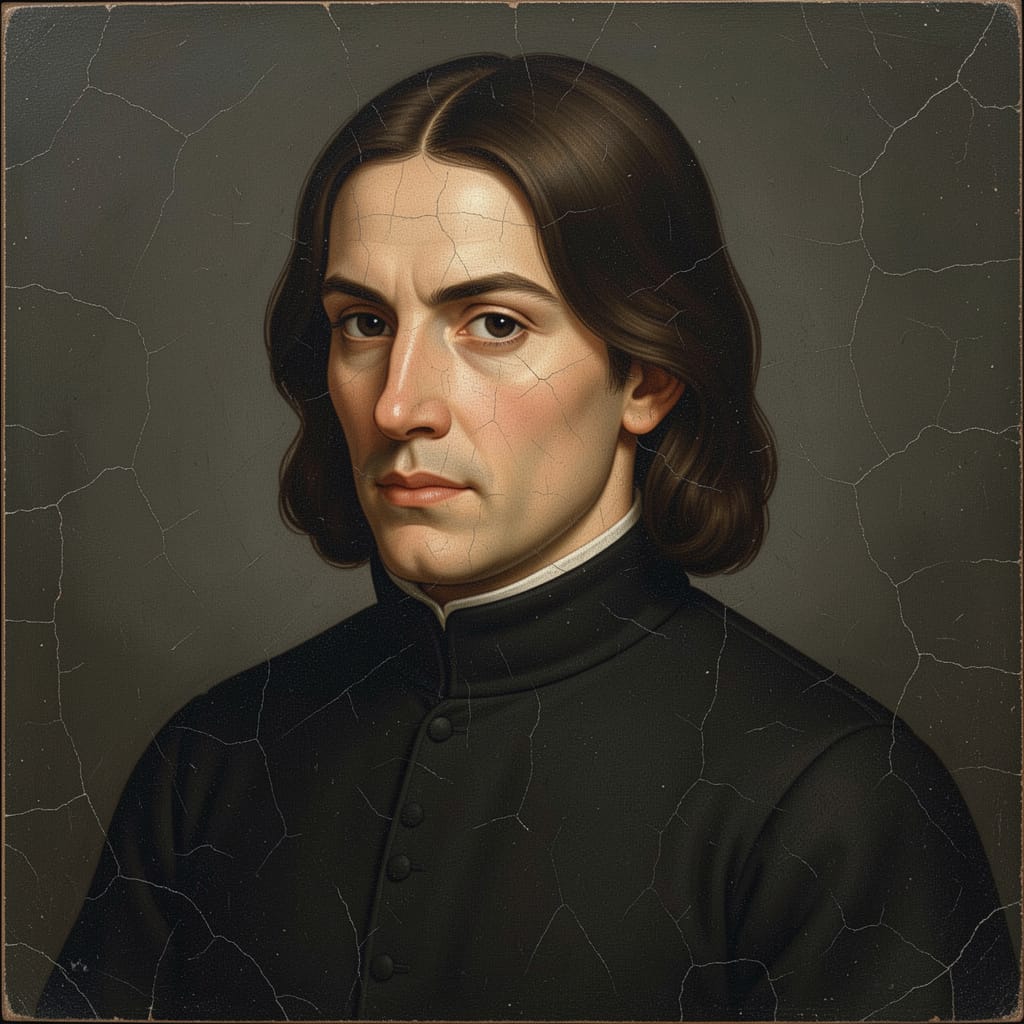
He didn't stop until he reached a small, sagging timber house squeezed between a tanner's shop and a bakery on the Rue Saint-Denis. The door was unlatched, swinging slightly on its rusted hinges in the wind. This had been the home of Maman Agathe, a widow who had kept a small fruit stall and had taken pity on Jean a decade ago when he was nothing but a starving, penniless student. She had slipped him bruised apples and stale bread, calling him her clever boy.
Jean pushed the door open and stepped into the dim interior. The hearth was cold.
"Agathe?" he called out, his voice shaking.
A weak, raspy breath answered from the corner. Jean hurried to the pallet bed. The moment his eyes adjusted to the shadows, a cold fist squeezed his heart. She was past helping. The skin of her face was already turning a mottled, bruised purple, and her breathing was a shallow, agonizing rattle. The plague had already claimed her lungs. Yet, when Jean knelt beside her, his knees sinking into the damp straw, her cloudy eyes focused on his face.
A frail, trembling hand rose, her fingers blackened at the tips, brushing against his wet cheek.
"You're a miracle, Jeannot," she whispered, her voice barely a thread of wind. "A true miracle... to come for an old woman."
Jean felt a lump rise in his throat, a dangerous surge of emotion that defied all his academic training. He forced his hands to remain steady as he reached into his leather satchel, pulling out clean linen strips. He knew the cloth was useless. He knew there was no medicine in the world that could reverse the rot in her chest. But he couldn't leave her to die like an animal in the dark.
"Not a miracle, Maman Agathe," he whispered softly, gently wrapping the clean white linen around her blistered wrists, wiping the cold sweat from her brow. "A doctor."
He stayed by her side in the freezing dark, holding her hand, whispering quiet words of comfort until the fever finally granted her a merciful, heavy sleep. As soon as her breathing stabilized into the deep, unresponsive slumber that preceded the end, Jean gently laid her hand down, picked up his satchel, and left as soon as she was asleep. His chest ached with a hollow, crushing weight.
He moved blindly down the next alley, seeking another door, another soul to fight for, until he stopped before a house that made him pause.
The air inside the small chamber was a wall of heat. After the freezing, lime-washed mud of the Paris alleyways, the room felt like a different world entirely. It was impeccably tidy—the small table scrubbed clean, the linens pulled taut across the mattress, not a speck of ash on the hearth. But what struck Jean first, making his hyper-sensitive nerves twitch, was the smell. It was an aggressive, suffocating flood of roses. It was too thick, too sweet, masking the faint, sour vinegar on his own leather coat like a heavy shroud.
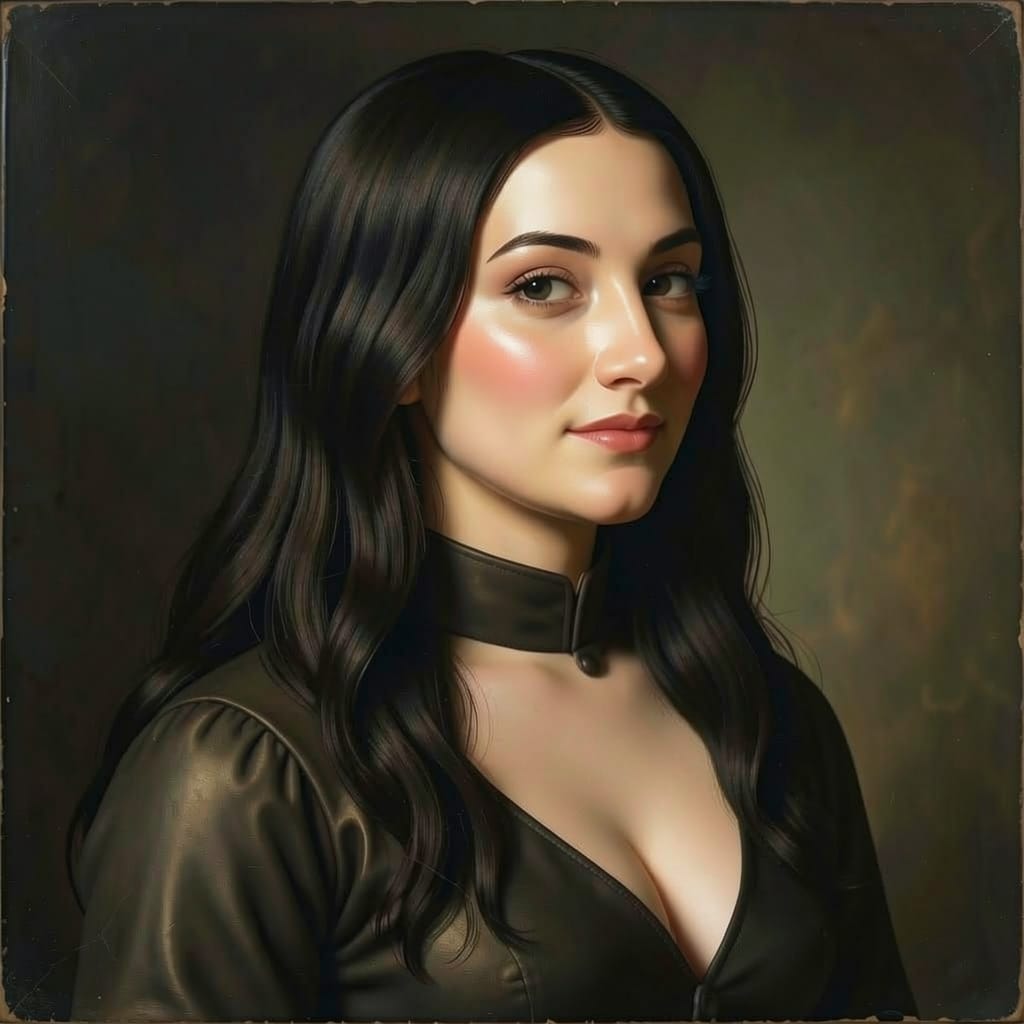
She stood near the washstand, a solitary silhouette against the single tallow candle that drowned in its own melting grease. She did not look like the others he had treated today. There was no gray exhaustion in her face, no panic in her eyes.
"Monsieur le médecin," she murmured, her voice a low, fluid thing that seemed to quiet the distant, rhythmic tolling of the plague bells outside. "You came."
Jean did not speak. His gray eyes, usually as cold and detached as a scalpel, scanned her with a rigid, professional intensity. His mind was already looping, hyper-focused on the invisible enemy killing the city. He didn't want conversation; he wanted to find the mark.
"Where is it?" he asked, his voice stiff with a physician's armor.
She smiled—a slow, sharp expression that made his pulse hitch—and stepped closer. The cloying scent of roses tightened around his throat. Without a word, she began to unlace her bodice, letting the heavy fabric slip from her shoulders. Piece by piece, her clothes pooled at her feet on the clean floorboards, completely disarming him. Her nakedness wasn't a submission; it was a challenge. She was entirely unblemished, her skin pale and perfect, an impossibility in a city of rotting flesh.
"Here," she whispered, her breath warm against his cheek as she guided his hand toward her collarbone, sliding his fingers down. "A lump. Right in the breast."
Jean’s fingers pressed into her skin. It was warm, but beneath the smooth surface, there was nothing. No swelling, no hard nodule, no heat of infection. He frowned, his professional pride instantly flared by the anomaly. Before he could question her, she stepped back onto the bed, parting her legs wide.
"And another," she breathed, gesturing down. "A tenderness. Like the start of a boil. On my inner thigh."
Jean knelt at the edge of the mattress, his gray eyes locking onto her inner thigh with obsessive, clinical focus. He searched for the telltale dark bruising of the pestilence, his fingers tracing the smooth skin, finding only flawless warmth. He was entirely caught in the riddle, staring intensely at her thigh, his brain desperately trying to force the medical reality to match his textbooks.
Suddenly, her fingers tangled firmly into his hair.
With a sharp, deliberate yank, she pulled his head forward and down, burying his face directly between her legs. The aggressive scent of roses hit his mouth and nose with a dizzying, overwhelming force. An old saying from his university days, muttered by black-cloaked instructors over open cadavers, flared in his hyper-focused mind: Death's own roses smell sweetest.
She looked down at him, her grip unyielding, completely shattering his clinical armor.
"You can't feel it?" she asked, her voice half-mocking, entirely playing with his desperation. "But you're not feeling it. I would have known..." She leaned over him slightly, laughing softly against the back of his neck. "Takes a woman, you know."
The boundary between a medical examination and a primal, suffocating desire dissolved completely in the dark. When he took her, it was not out of tenderness, but a desperate, frantic attempt to conquer the mystery she presented.
Yet she knew precisely how to command his worship. In the shifting shadows, he surrendered to her whims like a helpless puppet, grateful merely for the cold horror of her touch—a zealot offering his bare flesh to the lash, giving up his soul to a faceless god.
Afterward, the heat in the room turned damp. The heavy velvet drapes kept out the midnight air, locking in the smell of sweat, tangled linen, and that relentless, aggressive scent of roses. It felt less like a bedroom now and more like a fever-ward.
Jean lay staring at the low timber beams of the ceiling. His skin was slick, cooled by a sudden draft that filtered through the floorboards, carrying the faint, vinegar-sharp tang of the plague-bleach he had washed his hands in that morning. The physical release had offered no real escape; instead, the silence that followed only allowed the ghosts of the day to crowd back into his mind. He could still feel the phantom pulse of a dying boy’s wrist against his thumb. His chest tightened with that familiar, obsessive knot—the frantic, looping thoughts of a man who could not switch off his own brain.
Beside him, the sheets rustled. She shifted, entirely unbothered by the suffocating gravity of the room. She moved with a slow, feline luxury, her skin pale against the shadowed bedding, completely untouched by the gray exhaustion that ruined his own face.
She leaned up on one elbow, looking down at him.
"I never knew your lot, doctors, were that good with women," she said with a smile that could cut you apart and leave you breathless.
Jean looked at her, rising up from the bed. The failure of the morning’s rounds pressed like lead behind his eyes.
"Evidemment," he said bitterly. "I am not that good."
"Why?" she asked innocently, stretching in front of him. Beckoning.
"Were I that good, I'd know how to help the dying," he said, the words coming out sharp, driven by the cold obsession that never let him sleep. "I'd give anything to know."
"Anything?" Her eyes glinted in the dimness, catching the dying candlelight. "You could sell your soul for... knowledge?"
She sounded incredulous, almost amused. Jean’s brow furrowed. The warmth of the room seemed to drop away. His gray eyes became cold, detached as a scalpel. He didn't see a woman anymore; he saw his own failure.
"It's my job," he said, his voice tightening with a sudden, rigid haughtiness. "I should know. Any doctor would do that to help his patients."
"But the people die, mon cher," she said, her voice dropping to a low, rhythmic purr. "Every day, plague or not. You can't beat death, can you?"
"I can halt it. I could... if I only knew."
The candle flame stopped flickering. The silence in the room became absolute, a dead weight pressing against his ears.
"Would you really trade your soul's freedom for that knowledge?"
Jean let out a long, slow sigh. The pride went out of him, leaving only a hollow frame. When he spoke, his voice was parched, dry, bone-hollow.
"Yes."
The word fell like a guillotine blade.
She smiled.
"I knew you would," she said, and catching his hand, placed it on her breast.
"Treat me again, monsieur," she laughed.
The sound was low and dark, closing over his head like water. And, as before, he couldn't defy her.
Jean opened his eyes to a gray, freezing light.
The heat was gone. The cloying, aggressive scent of roses had vanished entirely, replaced by the sharp, stinging stench of rotting wood, stale urine, and cold damp. He was shivering, his skin goose-pimpled against the coarse, stiff fabric beneath him.
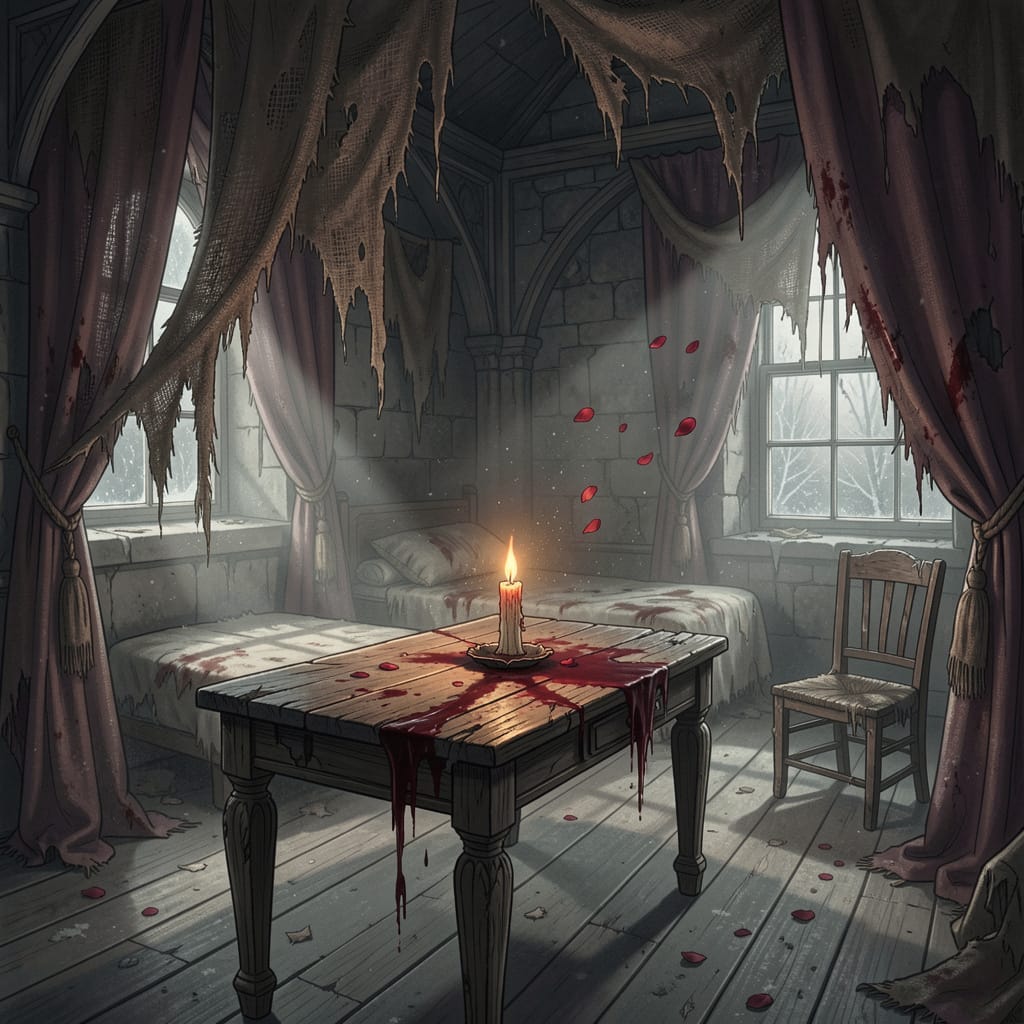
He bolted upright, his heart hammering against his ribs. The bed was not the clean, tautly made mattress from the night before. The sheets beneath him were frayed, yellowed with age, and mapped with ancient, greasy stains. The heavy velvet drapes were gone; in their place hung rotting rags of burlap, letting in a sharp, drafty wind from the derelict alleyway outside.
There was no woman. The washstand was empty, covered in a thick layer of undisturbed, gray dust. A broken chair lay on its side in the corner. The room had clearly been abandoned for years.
Jean scrambled off the mattress, his breath catching in his throat as his boots hit the rotting floorboards. "Mademoiselle?" he called out, but his voice sounded thin, rattling hollowly off the bare stone walls.
He looked down at his hands, expecting to find the gray, dark blemishes of the pestilence. He felt his own pulse—it was steady, impossibly calm, beating with a terrifying, rhythmic permanence. He felt no fatigue. The leaden ache behind his eyes from months of sleepless rounds was completely gone. He felt... hollowed out. Crystallized.
Panic driving him, he grabbed his leather coat from the floor and burst through the decaying door frame, stumbling out into the gray light of the Paris street.
The morning air smelled of quicklime and sulfur. A cart filled with tangled, pale limbs was already groaning down the mud-slick lane. Jean stopped, his breath freezing in his chest as the driver walked past him.
Suddenly, Jean’s mind exploded with a cold, unearned torrent of information.
He didn't just see the driver; he saw through him. Without wanting to, his eyes locked onto the man's chest. The fabric of the wool tunic seemed to dissolve into a transparent, ghostly shimmer. Jean could see the lungs underneath, blackening from the edges inward, the tissue liquefying under a microscopic swarm of dark, cellular violence. He saw the exact path the poison was taking through the bloodstream, tracking the precise hour and minute the man’s heart would give out.
He looked at a woman weeping on a doorstep. Her skin looked normal, but Jean’s vision peeled back her flesh like a phantom scalpel. He saw the swelling nodes deep within her groin, the blood vessels ready to burst under the pressure of the plague. He knew, with absolute, cosmic certainty, the exact biological mechanism of the disease. He understood the fluid dynamics of the contagion, the hidden pathways of its transmission, and the impenetrable defensive wall that had suddenly formed around his own cells, granting him absolute, permanent immunity.
He possessed the ultimate knowledge of the Black Death.
Frantic, driven by a sudden surge of professional pride, Jean rushed toward the weeping woman. "Listen to me," he gasped, reaching down to press his fingers against her throat, his mind rapidly calculating how to halt the progression he saw inside her. "I know what it is. I see where it hides."
But as his fingers touched her skin, the cosmic knowledge in his brain went dead.
He saw the disease with perfect clarity, but when he tried to formulate a cure, his mind hit a smooth, featureless wall. He knew how it killed, but the curse allowed him no way to stop it. He had no remedy, no treatment, no voice to guide them out of the dark. He was a passive observer, granted absolute immortality and immunity, but cursed with zero ability to save a single soul.
He was just a mirror reflecting their inescapable doom.