

The Delorme Way
Chapter 3

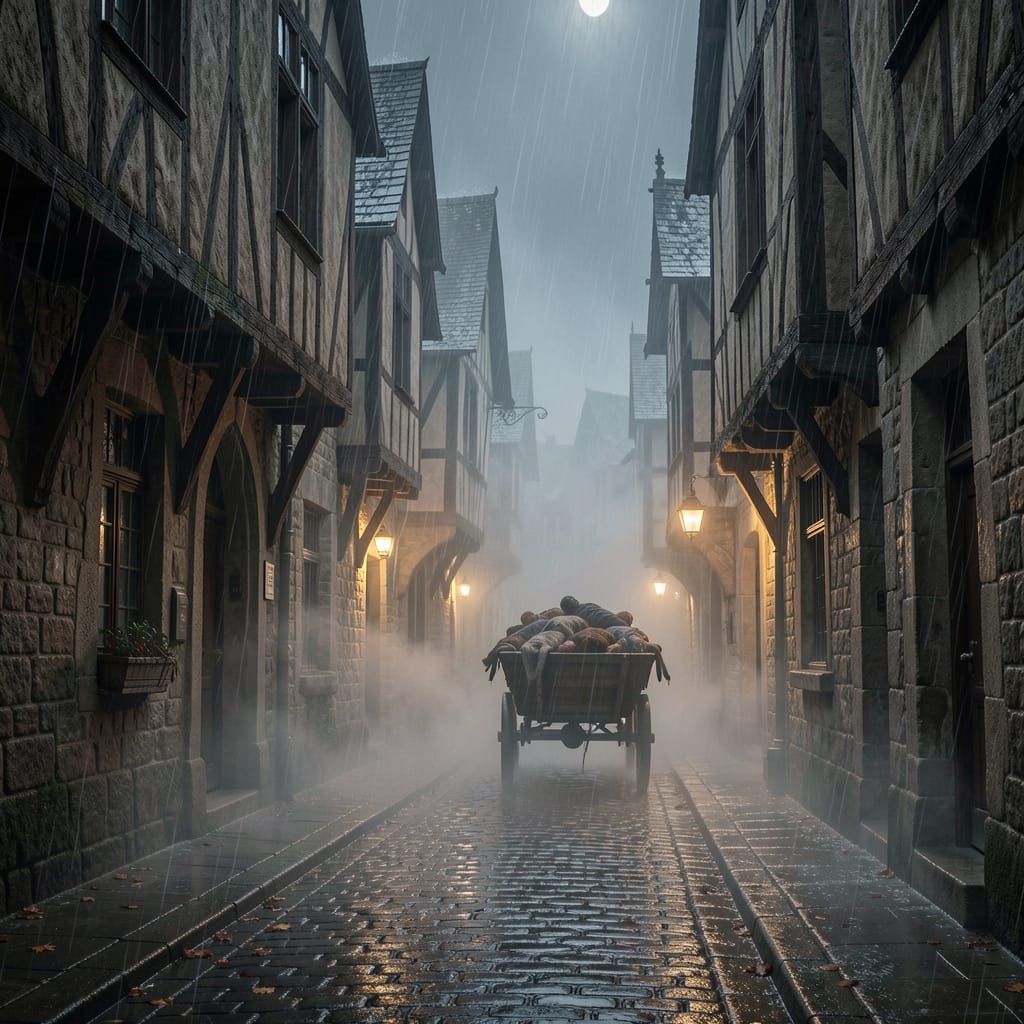
Jean pushed blindly through the gray light of the Paris lane, his boots skidding on the lime-washed mud. His chest heaved. He closed his eyes, pressing his palms against his temples until the bone creaked, praying for the textbook reality of his university years to slide back into place.
I am mad, he thought, the words a frantic, jagged rhythm inside his skull. The sleeplessness. The rot of the wards. The brain simply breaks under such weight.
But when he opened his eyes, the world did not mend. It became transparent.
He turned and fled away from the alleyway, his cloak snapping against his heels. He pushed into the Marché-aux-Fleurs, seeking the open air of the Seine to wash the rose-scented nightmare from his throat. The market was a ghost of itself, the flower stalls long abandoned, replaced by raw, unpainted stacks of empty coffins. Near a stone trough, a municipal water-carrier was hoisted under a heavy wooden yoke, sloshing river water onto the stones. Jean lunged past him. As he did, his gaze pierced the man’s wool tunic.
The stomach was already a dark, churning furnace of infection, the blood vessels fracturing, spilling a quiet, internal hemorrhage down toward the bowels. Sunset, the curse whispered in Jean's brain. He will drop the buckets by sunset.
"Stop it!" Jean shrieked aloud, stumbling over a discarded wicker basket. A passerby, his face muffled in a vinegar-soaked rag, veered away from him in terror, pronouncing Jean another casualty of the frenzy.
He was running now, driven by a primal need to outrun his own eyes. He reached the foot of the Pont Notre-Dame, the great wooden bridge spanning the gray, sluggish waters toward the right bank. The bridge was heavily crowded with tenement houses built directly over the water, their timbers groaning in the winter draft. Halfway across the span, the crowd bottlenecked behind a stalled plague-cart. Jean was forced to a halt, his breath freezing in thick, ragged plumes. He pressed his back against the rough wood of a housefront, his hands clawing at the cedar shingles.
Then, his eyes dropped.
A small child, a girl no older than his youngest sister in Moulins, was sitting on a threshold, playing with a piece of frayed rope. Jean tried to look at the sky, at the river, at anything but her. His mind hit that smooth, featureless wall—the remedy was blank, the diagnostic sight absolute.
His eyes locked onto her small frame. The dirty smock she wore dissolved. He saw through the ribs, into the delicate, fragile machinery of her chest. The dark cellular violence had already reached the valves of her heart. It was a beautiful, terrifyingly precise grid of destruction, tracking upward to her throat. The poison was moving with a slow, feline luxury.
Twelve minutes.
The girl looked up, her pale eyes meeting his detached, scalpel-sharp gaze. She gave him a small, innocent blink. Jean let out a parched, bone-hollow sob. He could see the exact second she would stop breathing, he could track the microscopic executioner under her skin, but his fingers, which had mended bone and stitched flesh, were completely useless.
Driven by a blinding wave of horror, he turned back. He could not cross onto the right bank; he could not carry this sight into the wider city. He fought his way back through the bottleneck on the bridge, his mind looping frantically, seeking an absolute darkness that could blind his terrifying eyes.
He ran down the Rue Neuve-Notre-Dame. The street was a narrow throat of timber-framed houses leaning so close overhead they blocked the sky, trapping the heavy stench of quicklime, sulfur, and human waste. Every face he passed was a horror. He saw a baker pulling a handcart; through the man’s leather jerkin, Jean watched the lymph nodes in his groin swelling into black, venomous clusters, the cellular violence accelerating with every stride he took.
An old woman was huddled against the stone foundations of the cathedral wall, her hands feebly outstretched for alms. Jean’s gray eyes locked onto her. His clinical armor was entirely gone, replaced by the unearned, terrifying torrent of sight. The fabric of her woolen shawl withered into a ghostly, shimmering veil. Beneath her skin, he saw her lungs—already pooling with dark, liquefied necrosis that crept upward like ink in water. A microscopic, violent swarm was chewing through her arteries, and a cold, silent clock chimed in Jean’s mind. Three hours. Thirty-four minutes. Her heart will burst before the vespers bell.
"Get away from me," he whispered, though she had not moved. He scrambled backward, his hands slick with the filth of the gutter.
He threw his weight against the massive, familiar shadow of the great cathedral doors, seeking an sanctuary, an altar, anywhere the transparent dead could not follow.
God was silent that day. There was no usual tremor upon entering, no peace under the cool vaults, no solace in the dimmed wax flames. No escape. Jean stood there, trying to pray, but his mind was beating madly against his heart, and even the singing had no power over a growing sense of dread.
Refugium meum tu es, Domine...
Yet, there was no refuge. The world was crumbling around him, and the smell of roses followed his every thought—stifling, suffocating, clouding his mind. He wanted to find a priest, to confess, to repent and ask for forgiveness, to be absolved of the sinful thoughts of returning there. He wanted to find the raven-haired woman and take her again, drag her to the altar of Notre Dame and ride her until the numbness ruled him. And then, when he was finally numb, crucify her—so his life might return to its normal state, stripped of this devilish knowledge of the plague, forged in intimacy and despair.
Refugium meum... tu es, Domine...
He kept repeating it until he stopped believing. Nothing made sense anymore. The plague would rage, he thought, and I shall be her messenger, her John the Baptist—unable to halt her, incapable of providing a cure. She would rage, reaping souls in her danse macabre, laughing mockingly at him, the arrogant fool who dared lie with her rose-scented daughter amidst the desolation and finality.
Oh Jeannot, Jeannot,
Mon paure nigaud,
T’en croyais triquar
La Mort,
Te v’là sa proye...*
He heard the canticle in his mind, like the songs he heard during his childhood years in Moulins. Those songs had been harmless children's play. This one was a cold, calculated taunt.
He fell to his knees, tears streaming down cheeks hollowed by insomnia, exhaustion, and mental self-flagellation. That was where Edouard found him, crouched on the damp stone.
------------------------------
* Oh Jeannot Jeannot
You foolish boy,
You thought you'd
Outsmart Death
But you fell first