

The Living Autopsy
Neurological Twinning and the Biometric Exoneration of Montague Druitt

Drawing Conclusions: Fifteen Years of Forensic Static
I was never made for family life—I just didn’t know it till my children turned 3, 5 and 9. I never knew that till I started working on Monty’s life, that feels surprisingly like my own—only, a far better version of it.
Now, I've talked at length about Monty, but if you're still not familiar with him, I welcome you to the Druitt Files, my on-going research into the life of Montague Druitt. He is the man who has been around for the last fifteen years of my life, and whose personality has intrigued me from the very moment I saw his picture in a book called Greatest Mysteries Never Solved.
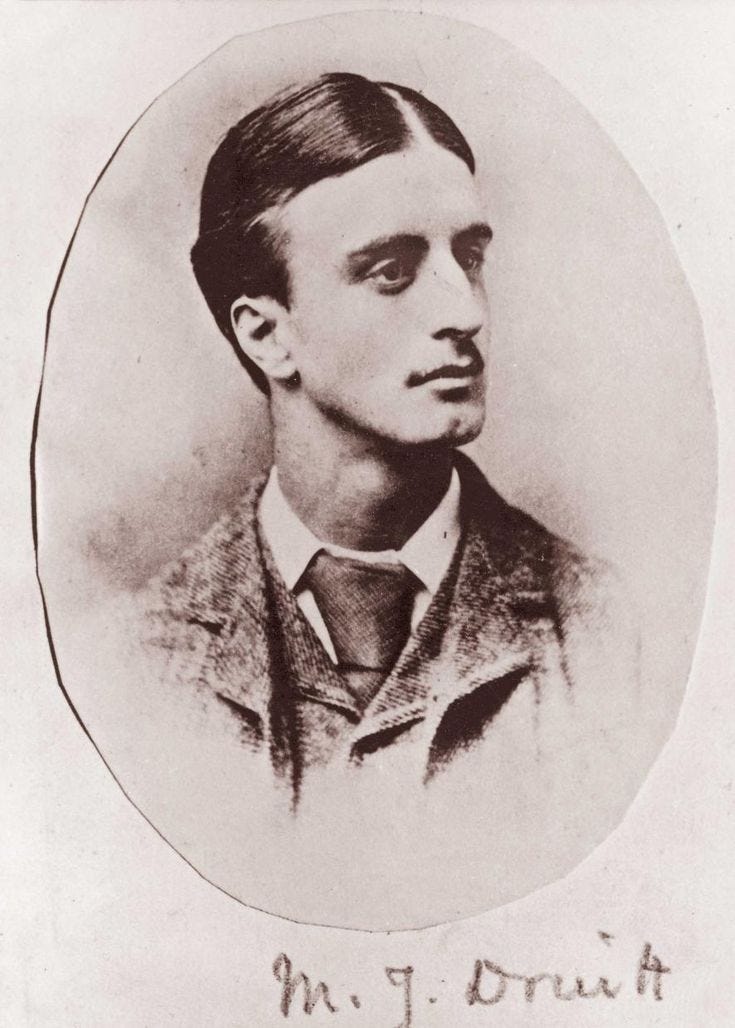
I was twelve when I first saw his picture in a book called Greatest Mysteries Never Solved. I didn’t see a murderer or a madman. I saw an incredibly familiar face—a profile I had been drawing since the first time I ever attempted to draw. He was a handsome, noble young man looking into the distance—but what I felt was more important. I felt immense, suffocating, sadness, a weight that seemed to extinguish the glow I perceived about him.
For the next years to come, Monty would come and go, only to return again—before the August ended and on New Year’s Eve, sometimes each year, sometimes, skipping a year, and I would wait for his return, for 1888 seemed very important—and I’d read everything I could find, noticing repetitive things and weird things—but nothing gave certainty. Nothing was truly there, except for the facts—very distorted or blown, only to fit into the true crime narrative. I’ve spent many hours on documentaries, but none talked of Monty, and if they did mention him, it sounded wrong. But there was no cohesive biography available, just my gut feeling, telling me they were wrong about him. You might say, aha, you saw a handsome guy and idealized him, but that was not the case. I didn’t see ‘a handsome guy’—I saw someone I knew.
I never dared looking deeper, but I had no backing of criminology, or Victorian era understanding—which, although sharp enough, still was an intuitive one. Monty would be there, sometimes politely pushing aside the Tudors and the Stuarts, and even his fellow Victorians, like Oscar Wilde and Lewis Carroll. He’d be a constant, unwavering presence—until that dream came.
Atmospheric Disturbances: A Cold-Call from 1888
It was around 2020, I think. I drifted off suddenly, reading—and found myself in a dreamscape that looked so real I almost woke up with a start. A darkened alley or a street, flickering gas lamps, and a wall of rain, torrential, cold rain separating me from what I thought was the river, rumbling in the distance. And someone walking through the rain. I watched him—a tall figure wearing a long overcoat, walking behind the wall of rain, his face indistinguishable, parallel to me. He moved slowly, and I watched, seeing him pass, and woke up.
The dream repeated itself in time—about a year, or so—but this time the figure seemed to be following a different trajectory—still behind the wall of rain, but closer, I could see how water washed over him, and how sad he looked. But as soon as he turned his head to me, I woke with a start. More time passed, and the dream came back. This time the figure was moving towards me, and although I was slightly alarmed, I resolved to watch on. He moved steadily and I felt he saw me—and suddenly, I gasped internally—his face was next to mine, and it was the face I have known since my teenage years. I was looking at Montague Druitt. Water was dripping from his hair, his face was pale, and his eyes seemed to look right into me.
‘Help me’ he breathed, and I woke up.
The Lawrence Proxy: When "Fiction" is Just Subconscious Filing
I’d be lying if I said I wasn’t scared. I was—but I knew one more thing: he would never return if I did nothing. Some months after that, strange things started happening. A voice appeared in my head—writers would get it—speaking about Monty. It was something quite new, for the voice had a name, and agency. The voice called itself Lawrence Graves, and he was in love with a young man. That’s how the monologue began:
“...now as I think of it, I was obsessed with him, beguiled, smitten. I watched him from afar, you might say, I watched over him—but I did not dare approach him, yet his demure charm and sadness lodged deep in his dark eyes kept me painfully longing for a contact... however brief.”
And I started writing. The year was 2025, and the month—January.Surprisingly, the narrative flowed, and Monty appeared there, not as a protagonist—just as Lawrence himself. They would talk, and Monty would come out as an eloquent, logical, highly empathetic, likeable and intelligent young man. I envied Lawrence, actually—their dynamic was a loving, respectful, very harmonious one, full of shared talks, walks and deep discussions. And the way Monty was described hinted at a very intimate knowledge of him—something that I could never claim. he writing took a year, and I realized I was more than a writer—I became a researcher, digging through books on London, Victorians, their lives and habits, and everything I found out was... familiar. It was as if I weren’t learning it for the first time, but remembering it.
Everything I wrote had a real-life basis, and sometimes I’d write things about Monty that just jumped off the pen, and I never knew where it all came from. And I suffered slightly, for my narrative was chronological, and I knew I had to face Monty’s death too. That was agonizing, the mere thought of going into it, because I felt it wasn’t a suicide case. By that time, you see, I have found out that Monty had no reason to jump into the river, and so I really needed more information. My gut told me he was helped, but would I dare?..
That’s how D.J.Leighton’s book - the mention of it - came across in one obscure article. I found the book - the only biography ever written on Monty (rather, on his cricketing success, for Leighton is sport historian mostly) - and I had to pay my last money for it, but I read it in a single night, and to my amazement, I saw the pictures in there. And there was one particular picture - of Monty’s brother, William - you can see it in this article, along with Monty’s father and his brother Edward.
It made my skin crawl. I felt nauseated, sick and gasping for breath. Panic took my brain for a hostage, literally. A voice kept repeating in my head: ‘THAT'S HIM’ followed by ‘You’re looking at my murderer’.
I genuinely feared I was losing my mind. By that time, I spent many months with Monty, rules of his life and his family. He wasn’t just a name, he was…alive. Biographers, I’m told, often get that aftermath of being immersed into the lives of their subjects, but I wasn’t a biographer then. I was a person following the gut feeling. Intuition.
Now, Leighton had a theory he postponed till the last pages, and it resounded painfully in my mind. He suggested Monty was killed by his brother for the inheritance. It felt only 50% right to me. But I wrote on, until I reached the chapters on Lawrence’s investigation.
To save your time, I was exploring the Victorian medical field then, and a certain tincture came into view. It clicked. The thing with that tincture was that it looked a lot like liquid strychnia. To quote Lindsay (1889):
‘The most generally useful of the drugs is strychnine... it should be given in small doses, and only in cases where there is not much nervous irritability.’
During the Victorian era, strychnine was widely utilized in various medical formulations—as a tonic for stamina, a cardiac stimulant, or even a topical treatment for paralysis.
That’s what hit me. That’s what turned the investigation in the book from theoretical to practical. But for that, Lawrence had to employ the knowledge of period-authentic methods, namely the Stas-Otto test, and I had to consult my brilliant friend Treading Water.- a pro in criminology. My own criminological background was still developing and needed reassurance. But as soon as it happened, I had the picture. It corresponded exactly with the things I felt when I looked at William’s face.
Forensic Specifications: The Three Pillars of Twinning
When the narrative was finally over, and sent out for reading, I realized I still had to dig deeper. I resumed my criminology studies, I wrote to the archives, and surpisingly, I got answers.
And the answers brought it - quite logically- more questions.
I have mentioned, I think, that Monty was familiar. So, upon seeing his handwriting and analyzing it, I thought…it did look like my own. It felt like it, anyway. So I went into graphological analysis.


The results took a long time - two months of tests, stress-tests, neurological profiling and all possible things. But finally, we’ve arrived to this:


That’s what, in forensic setting, is called neurological twinning - the hypothesized structural and motor alignment between a modern researcher and a historical subject. It moves beyond psychological empathy into the realm of biometric mirroring, where the researcher’s nervous system functions as a “proxy” for the subject’s cognitive and motor patterns.
As a forensic concept, it is defined by three primary pillars:
Motor Program Resonance: The subconscious replication of Angular Velocity (writing speed/rhythm), Baseline Integrity (mental organization), and Pressure Patterns (visceral stress) that match the historical subject’s authentic records.
Biometric Barometry: The phenomenon where the researcher’s hand acts as a “lie detector.” It maintains high-resonance with authentic historical identities but physically deforms (0% match) or recoils when forced to interact with faked evidence or historical distortions.
Psychosomatic Reconstruction: The manifestation of “period-authentic” physical distress—such as nausea, gasping, or localized tremors—triggered by specific forensic stimuli (photographs of suspects or weapons) that the subject would have experienced.
System Requirements: The Daughter of Neuropathologist
Remember I told you I wasn’t suited for family life? Well, I have a reason to say that. After all the tests I went through during this last year, I’ve found out some adorable truths about me that explain pretty much everything.
The diagnostic results weren’t just labels; they were the system specs for the twinning. I am an HSP, which means my central nervous system is wired with a ‘porosity’ far above the norm. My father is a neuropathologist, and he never guessed that. He technically never saw me that way, and my adolescence was a constant battle with him, trying to prove my stance on things. Along with that, the people around me kept telling me I would be a fantastic guy. That, combined with my school nicknames—‘Devil’s Advocate’ and ‘Oscar Wilde’—should give you a pretty clear picture of me before university.
I have an inner injustice indicator that never turns off. I have a university debating past because I crave logical integrity. Then there are the ‘redirects’: despite my father’s field, when he pushed me into clinical psychology, the universities repeatedly refused me. I never worked in it. I was offered International Law, but I chose Journalism—only to find it was actually PR, which my system almost hated. To an Advocate (INFJ), PR is the artificial construction of a narrative. I couldn’t spend my life polishing masks; I was meant to dismantle them.
I’ve spent five years teaching English to kids; since I was five, I’ve been obsessed with London. When I finally visited, it wasn’t new; it was a visceral confirmation of a map I already had in my head. I gravitate toward lawyers and forensic characters in movies and series because that’s what my nervous system is, and towards Victorian setting because it’s my nature.
The Hannibal Graham Protocol: Identifying the Family Predator
Essentially, I’m Will Lecter. Or Hannibal Graham. Only, I’m almost vegetarian, preferring chicken to meat. And people. My system, which rejected the ‘spin’ of the modern world, finally found the one narrative it couldn’t ‘spin’: the truth of a murder. The twinning happened because I am the ideal forensic proxy—the daughter of a neuropathologist, sensitive enough to catch the rhythm (HSP) and masculine enough in perception to carry his voice back from the river.
The Victorian in Exile: Maintenance of the Instrument
Living this every day isn’t a hobby, and it is no longer a biography. It is a reclamation.
I exist in a constant, high-tension friction between two worlds. I am here, in a Russian-speaking environment, thousands of miles from the London streets my nervous system recognizes as home. To the world, I’m a mum, a daughter, a wife, a teacher, a translator—someone who increasingly recoils at using Russian, as it no longer holds me; it only chains me down.
I am surrounded by the domestic noise of children and a husband—a decent man, certainly, but one who cannot possibly meet me at this neurological depth. He sees his picture on my nightstand and sometimes feels the pull of jealousy, but I know it is not what he thinks it is. It is a reminder of a core that is invisible, yet so palpable. It is a visual anchor for a man whose hand I am figuratively holding across a century.
Every detail of my day is a sensory calibration. I write with fountain pens on unlined paper; I use Penhaligon’s “Brilliantly British”—perhaps not the Hammam Bouquet of the 1870s he would have known, but the house is the same, the olfactory DNA is there. The only thing I don’t have is a Victorian suit; in all other aspects, I hit the mark. I am a Victorian mind enduring a 21st-century assault.
For an HSP, the world is already a sensory violation; I physically ache at the sound of raised voices, and music is a tide that doesn’t just play—it consumes. Yet, I do not break. I possess a Victorian detached decorum that allows me to remain composed under a level of stress that is literally turning my hair white.
I am performing a living autopsy while the kettle boils. I am dismantling a 130-year-old murder conspiracy while helping with homework. To my own nervous system, I am the only piece of admissible evidence Montague Druitt has left. I have stopped “studying” him; I am simply holding the space where his integrity was stolen, refusing to let the noise of the present drown out the logical, eloquent silence of 1888.
I don’t know how dangerous it makes me, but my gut tells me it does.